
Week of 2/9 - 2/13
- Feb 12
- 2 min read
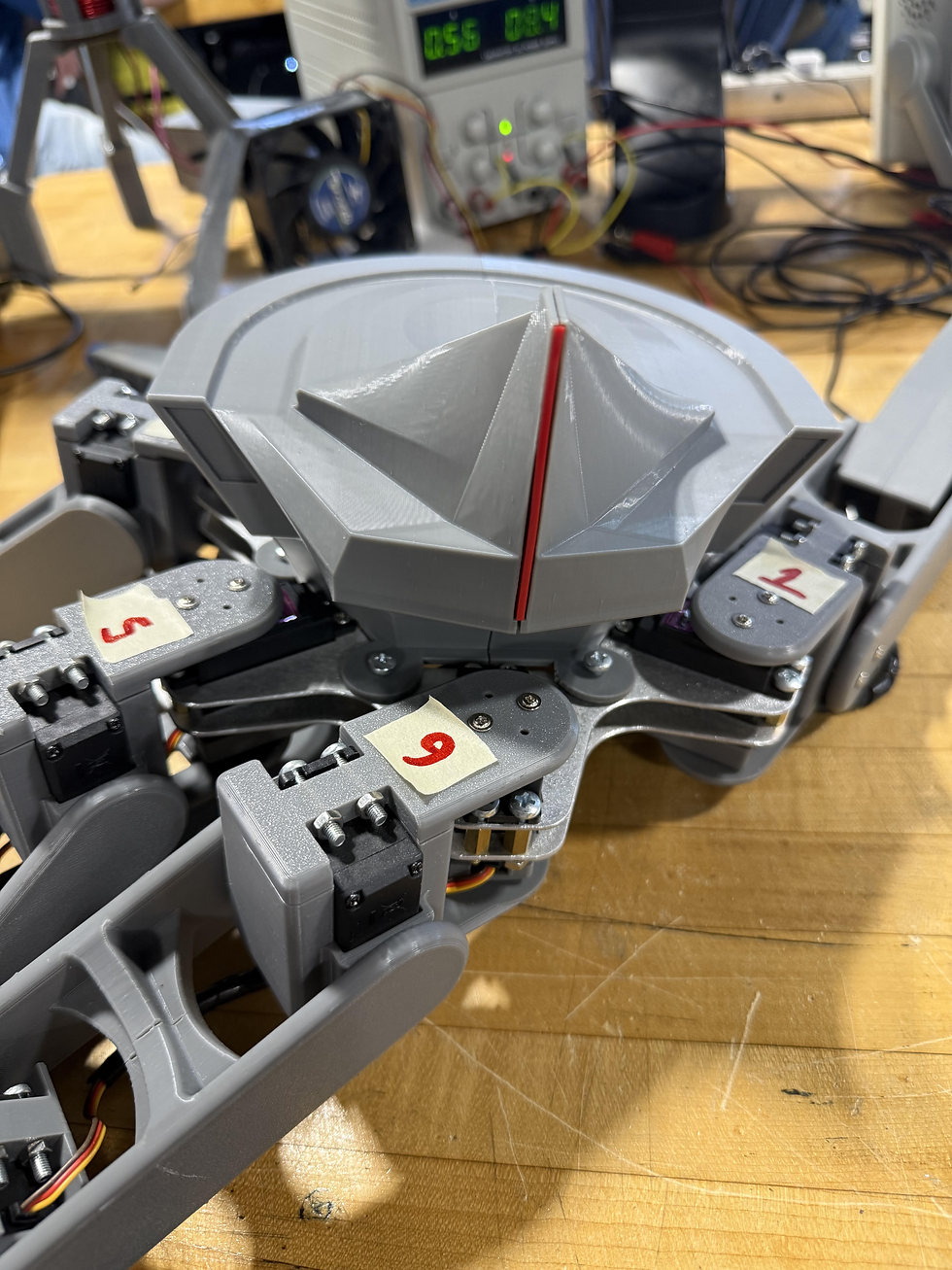
This week, I didn't really have much to work on since I was still waiting on the new microcontroller for the servos, which broke last week. I still had a couple of other things to work on for my robot, though, so I primarily did that this week. One of those things was wire management, which, after attaching all 18 wires, so they were about last week, I realized I was severely lacking in.

In order to fix the wire management issue, I had to first make the foot wires longer since, at their base length, they barely reach the board. When they bend too much, the pins get bent, which wasn't going to work for me since I need them all to be working at the same time. There'd be no room for the wires to bend, so it could damage the motor if I kept them like that.

I saw this issue just by soldering an extra wire onto the end of it, and this took a bit of time since I accidentally soldered the wires on without any shrink wrap beforehand. So, I wasn't able to attach it after, and I had to re-solder all the wires since the shrink wrap was essential in making sure that the wires don't touch.

eventually, though, I got them all soldered, and all I had to do now was to wrap all three of the leg wires into one. But I was kinda done with wire management at this point, so I decided to take a break from that. I saw a video of something pretty interesting, though. So I wanted to see if I could make a much smaller version of it.

It's a circuit called a Marx generator, and essentially what it does is take capacitors that are in parallel, charge them up, then switch them to series in order to produce a much higher voltage. The voltage is multiplied by the number of capacitors since in series, voltage is additive, while in parallel, the voltage is the same across all of them.

This would also, in theory, let me charge up much bigger capacitors, since right now I only have access to 30 volts, really 25 volts with a power supply. But I wasn't able to fully create the mark generator. I had to create a manual one since, in a real one, you need spark gaps, but since I didn't have high enough voltage, those weren't feasible. So, I had to try to stick with switches instead. This didn't really work, though, and I'm still trying to see what the issue is. I think it has to do with the soldering job because there was a lot of soldering that I had to do, and I think some of the wires must be touching in the circuit.


Comments