
Week of 2/2 - 2/6
- Feb 6
- 2 min read
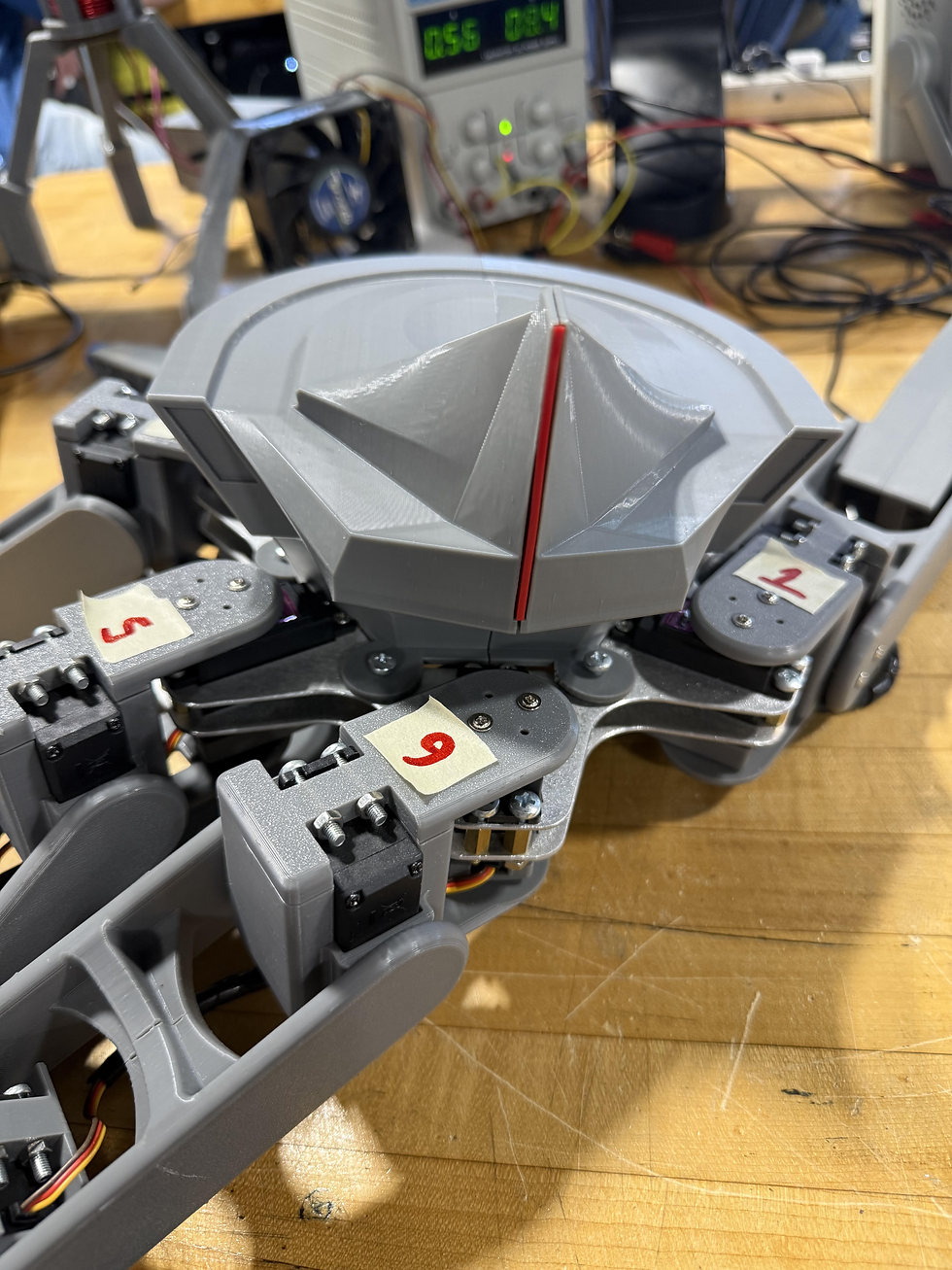
at the start of this week, I was mainly focused on getting all the legs working synchronously. I was having a bit of an issue because on the board, pins 1 and 2 were synced up with 17 and 18. So, I had to have them do the same exact thing at the same exact time, or else nothing would work. I did manage to get the robot to go up and down though, which is really nice. And I only had one part of the leg missing because I needed to solder those wires still.

I saw the wires, and I was going to try it again, but for some reason, the board short-circuited and kinda fried this one part. I tried a couple of different ways to fix it, but I realized that it probably wasn't going to work anymore, and I needed to order a new one. I really don't know why this happened because I don't think I did anything wrong. But it seemed like the power was just too high at a certain point, so maybe I was asking too much of the motors. But nothing had happened beforehand, so it's kind of a mystery to me.

I then tried to cut the USB power and the external power strip because I thought that might make it work, since I was powering it with the external power rather than the USB power anyways. The part that broke looked like it connected to the USB power, but this didn't really do anything. So I think it's not an issue about power, but rather just that one piece that was bridging a gap, and now that gap is gone.

I decided to get a part to try and fix that board that I have right now, but also just to order a new board in case that doesn't work. While those were coming, I was suggested to try to look at different boards. So I started looking at a couple of different options instead of the board I'm using now. This 8-channel board looks pretty good since I can just add more if I need more slots. It would solve the issue of pins 1 and 2 in 17 and 18 being connected on the previous board, which would be really helpful when I want to move all six legs independently.

another feature of this board that would help me is the fact that it is much easier for me to use it to connect to the ESP32. It would allow me to code directly on the ESP32 and have the servo controller just act as a way to transmit the code to the servos, rather than having the code actually on the board itself. I was researching how this connection would be different, but it didn't seem very difficult, and I should be able to do it pretty easily with just an I2C connector.



Comments